

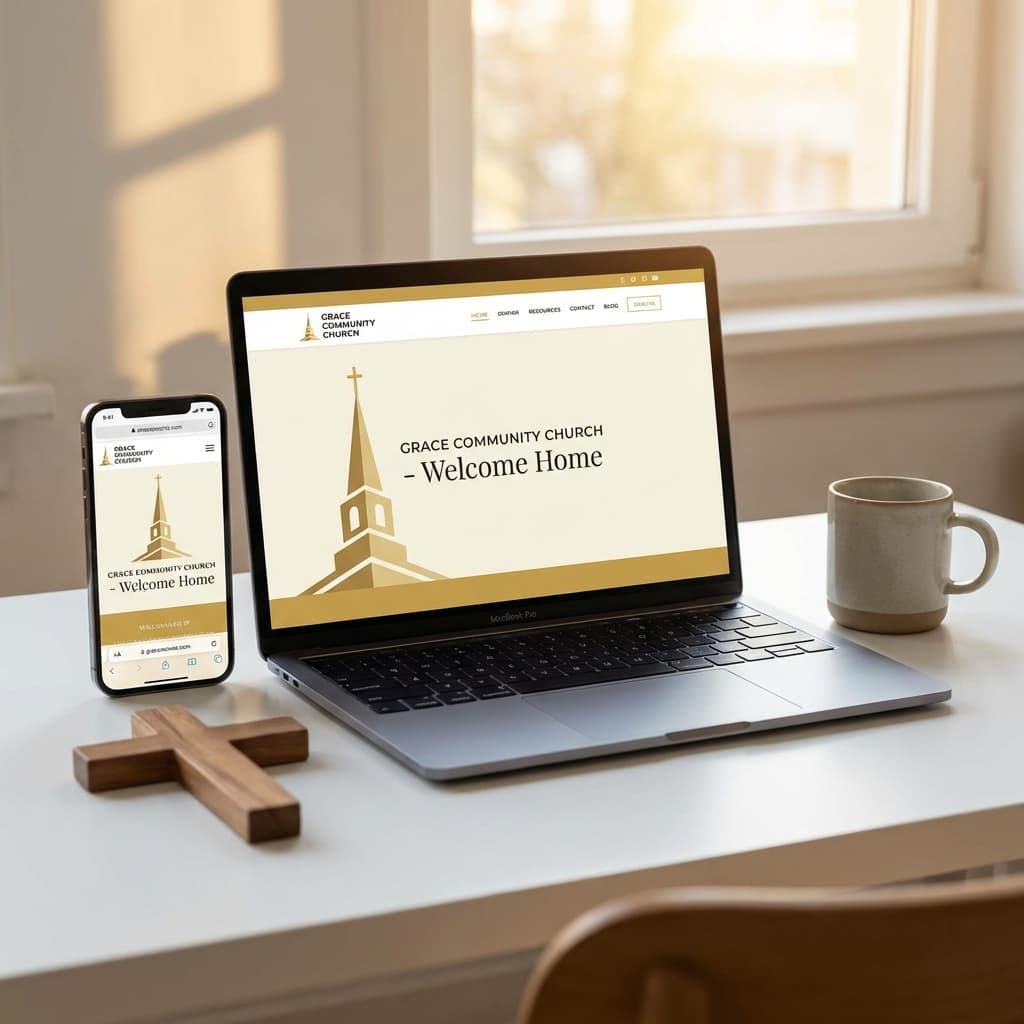
Before most people ever step foot in your church, they visit your website. They check service times, look at photos, read about what to expect, and decide whether it feels like a place they'd want to visit. All of that happens in about 10 seconds.
Your website is your digital front door. And just like your physical building, it says something about your church before anyone walks in. The question is: what is it saying?
The Three Things Every Church Website Needs to Get Right
Church websites don't need to be fancy. They don't need animations, video backgrounds, or custom illustrations. But they do need to get three fundamental things right. If any of these are missing, visitors are leaving before they ever give your church a chance.
Security (SSL)

You've probably noticed the little padlock icon in your browser's address bar. That padlock means the website is using SSL, which encrypts the connection between the visitor's browser and your website. When it's missing, browsers show a "Not Secure" warning instead.
Why does this matter for a church? Two reasons.
First, trust. If someone visits your church website and sees "Not Secure" in their browser, they're going to hesitate. They might not know what SSL means, but they know what "Not Secure" means. It feels wrong. And for a church that's asking people to trust them with something as personal as their spiritual life, that first impression matters.
Second, Google cares. Sites without SSL get pushed down in search results. So that "Not Secure" warning isn't just scaring away visitors who find you. It's also making it harder for people to find you in the first place.
The good news: SSL is usually free and straightforward to set up. Most modern hosting providers include it automatically. If your site doesn't have it, this is one of the fastest, highest-impact fixes you can make.
Mobile Responsiveness
More than 60% of people who visit church websites are on their phones. Not sitting at a desk with a big monitor. On their phone, probably in a parking lot on Sunday morning, trying to find out what time the second service starts.
A mobile-responsive website adjusts its layout to look good on any screen size. Text is readable without pinching and zooming. Buttons are big enough to tap with a thumb. The menu works. The address and service times are easy to find.
If your website was built more than five years ago and hasn't been updated, there's a good chance it doesn't work well on mobile. The design might look fine on a laptop but fall apart on a phone. And when that happens, people don't try harder. They leave.
This isn't about aesthetics. It's about accessibility. If a first-time visitor can't find your service times on their phone in 10 seconds, you've lost them.
When evaluating your website's performance, it's helpful to prioritize your church's digital marketing improvements based on what will have the biggest impact on visitor experience.
Social Media Links
Your website and your social media should work together. When someone discovers your church online, they might land on your website first, or they might find your Facebook page first. Either way, they should be able to get from one to the other easily.
Social links on your website serve a few purposes. They let visitors see your church in action through photos, videos, and real-time posts. They give people a low-commitment way to stay connected (following on Instagram feels less formal than signing up for a newsletter). And they signal that your church is active and engaged, not just a static brochure on the internet.
Why Regular Check-Ups Matter
Websites aren't static. They change over time, sometimes in ways you don't notice. A plugin update breaks something. The hosting provider changes servers and now pages load slower. Someone adds a high-resolution photo that's 8MB and didn't realize it would make the page crawl.
The same way you'd walk through your church building to check that the lights work and the bathrooms are clean, your website needs periodic attention. Not a full redesign. Just a check-in.
Here's a quick list you can run through every few months:
- Pull up your website on your phone. Can you find service times in under 10 seconds? Does the menu work? Do the pages load quickly?
- Check for the padlock. Is your SSL certificate active? If you see "Not Secure" in the browser, contact your hosting provider.
- Click your social links. Do they all work? Do they go to the right pages? Is your Facebook link pointing to a page that's actually been updated recently?
- Try the "new visitor" test. Pretend you've never been to your church. Open your website cold. Can you answer: When are services? Where is the church? What should I expect? If any of those take more than a few seconds to find, that's worth fixing.

Your Website Is Part of Your Welcome Ministry
Think about how much care your church puts into greeting visitors on Sunday morning. The welcome team, the signage, the clean lobby, the fresh coffee. All of that exists because first impressions matter and because you want people to feel welcomed before they even sit down.
Your website is the same thing, just earlier in the journey. For many visitors, it's the very first interaction they have with your church. It's where they decide whether to show up or keep scrolling.
Getting the basics right isn't about being tech-savvy. It's about hospitality. A secure site says "you can trust us." A mobile-friendly site says "we thought about you." Working social links say "we're real people, and here's what our community looks like."
Not sure how your church needs SEO? A free marketing audit will check all of this and give you a clear picture of where you stand.